Programs: Doctoral School CYU and Master 2 in Mathematics.
Lectures: 10 lectures of 3h, 13h30-16h15.
Dates: Tu Jan 13, Th Jan 15, Tu Jan 27, Tu Feb 3, Tu Feb 10, Tu Feb 17, Th Feb 19, Th March 19, Th March 26.
Exercise Seminar on Spectral Theory (V. Rossi) 10h-12h : Tu Feb 10, Tu Feb 17, Th Feb 19, Th March 19, Th March 26.
Final exam: April 9 2026.
Learning objectives
The main goal of this course is to introduce the audience to the mathematics of quantum disordered systems and phase transitions in condensed matter physics, by studying the Anderson model and its mathematical framework, the theory of Random Schrodinger Operators. The Anderson model was discovered by physicist P.W. Anderson in 1958, for which he got the Nobel Prize in Physics in 1977, and started an accelerated development of mathematical tools known as the theory of Random Schrödinger Operators. The main feature of this model is the existence of a localized phase where electronic transport is absent. Here, the transport is suppressed by the presence of impurities modeled by random variables in a suitably defined probability space, a phenomenon known as “Anderson localization”.
The particular goals of the course include understanding how probability, functional analysis and dynamical systems enter the mathematical modeling of quantum phenomena, and more specifically, to understand the current methods that exist in arbitrary dimensions to show the decay of the Green’s function, which plays a key role in the spectral and dynamical theory of these systems.
The course focuses on techniques available for arbitrary dimensions. For specific tecniques in one-dimensional and quasi-one dimensional systems, see the course of H. Boumaza.
Prerequisites: Linear Algebra, Measure Theory, Complex Analysis, Functional analysis and Probability. A basic knowledge of Stochastic Processes, Analysis of PDEs and Harmonic Analysis is an advantage, but not completely necessary to follow the course.
Contents
- Motivation. Linear operators in Hilbert spaces as a framework for Quantum Mechanics. Schroedinger’s equation and time evolution of a system.
- Schrödinger Operators. The discrete Laplacian and Fourier Transform. Recall of Spectral theory of bounded operators. Geometric Resolvent Identity, boundary conditions. Brief introduction to the continuous setting.
- Ergodicity. Recall of notions of probability theory. Definition of ergodicity, random operators, the Anderson model and its variants. Existence of Almost-Sure spectrum and characterization of the spectrum of a random operator.
- Spectra and dynamics. RAGE Theorem. Relation between spectral type and dynamics. Moments of wave packets and definition of transport exponents
- Anderson localization and Dynamical localization. Phase diagram and conjecture of the Metal-Insulator Anderson Transition. Transport exponents in regions of localization and delocalization. Existing methods to prove localization in dimension one and arbitrary dimension.
- Methods to prove dynamical localization I: The strong disorder regime: (1) A proof of localization at strong disorder : Green’s function expansion in SAW (self-avoiding random walks) following Schenker’s approach. (2)The Fractional Moment Method by Aizenman and Molchanov.
- Methods to prove dynamical localization II: The Multiscale Analysis by Froehlich and Spencer. Density of States Measure and Integrated Density of States. Lifshitz tails (Analytical proof and probabilistic proof).
Bibliography
Lecture notes
- Kirsch, W. (2008). An invitation to random Schrödinger operators. In Random Schrödinger Operators (Vol. 25, pp. 1–119). Société Mathématique de France. Preprint available at [0709.3707] An Invitation to Random Schroedinger operators
- Stolz, G. (2011). An introduction to Anderson localization. In Entropy and the Quantum II: Arizona School of Analysis with Applications (Vol. 552, pp. 71–108). American Mathematical Society. Preprint available at [1104.2317] An Introduction to the Mathematics of Anderson Localization
- Rojas-Molina, C. (2018). Random Schrödinger Operators on discrete structures. In Spectral Theory of Graphs and Manifolds (Vol. 32, pp. 147–187). Société Mathématique de France. Preprint available at [1710.02293] Random Schrödinger Operators on discrete structures
- Boumaza, H. Lecture notes on Bounded Operators 2025-2026-M1-BoundedOperators.pdf
Books
- Aizenman, M., & Warzel, S. (2015). Random Operators: Disorder Effects on Quantum Spectra and Dynamics. Springer.
- Borthwick, D. (2020). Spectral Theory: Basic Concepts and Applications. Springer.
- Carmona, R., & Lacroix, J. (1992). Spectral Theory of Random Schrödinger Operators. Springer.
- Pastur, L. A., & Figotin, A. L. (1992). Spectra of Random and Almost Periodic Operators (Vol. 297). Springer-Verlag
- Lein, M. (2022) A Mathematical Journey Through Differential Equations of Physics. World Scientific.
- Teta, A. (2018). A Mathematical Primer on Quantum Mechanics. Springer.
- Hall, B. C. (2013). Quantum Theory for Mathematicians. Springer.
- Lewin, M. (2024). Spectral Theory and Quantum Mechanics. Springer
- Borthwick, D. (2020). Spectral Theory: Basic Concepts and Applications. Springer.
- Reed, M., Simon, B., Methods of Modern Mathematical Physics, vol 1: Functional Analysis, vol 4: Analysis of Operators.
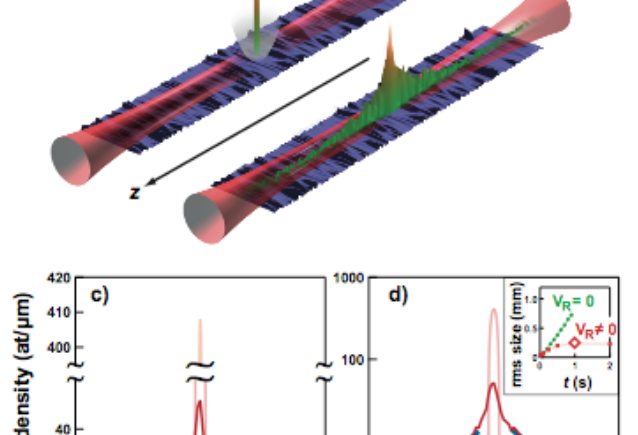
Featured image: Billy, J., Josse, V., Zuo, Z., Bernard, A., Hambrecht, B., Lugan, P., Clément, D., Sanchez-Palencia, L., Bouyer, P., & Aspect, A. (2008). Direct observation of Anderson localization of matter waves in a one-dimensional optical disorder. Nature, 453(7197), 891–894. https://doi.org/10.1038/nature07000